
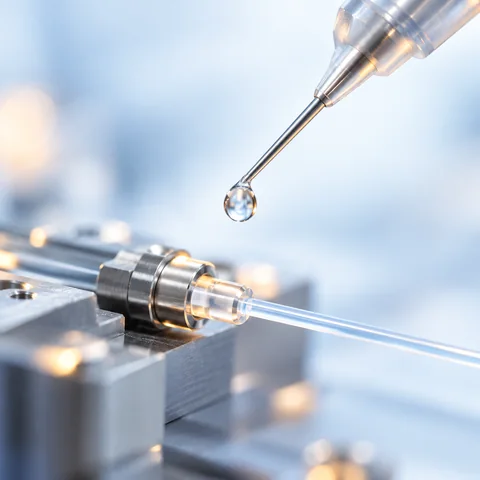
Define the coil construction
Record the fiber type and coating, winding diameter, layer count, spool or support materials, winding tension and the regions that require bonding.
Control adhesive placement
Specify dispense volume, bond pattern, penetration or wetting limits and the surfaces that must remain free of adhesive so the assembly can be reproduced.
Map UV access and cure conditions
Document UV access, irradiance or dose control, shadowed regions, fixture arrangement and the sequence used to cure the complete bond pattern.
Evaluate cure and thermal stress
Measure the finished coil rather than inferring stress from a single bulk property. Include cure movement, temperature cycling and the substrate combination.
Qualify optical and mechanical stability
Define insertion-loss or attenuation checks, handling loads, thermal and humidity exposures and post-test inspection for the intended coil assembly.
INFORMATION CHECKLIST
Prepare these details for a productive material discussion.
- Fiber, coating and winding geometry
- Support materials and winding tension
- Adhesive placement and dispense control
- UV access and cure sequence
- Finished-coil optical and reliability tests
TECHNICAL FAQ
Questions to clarify before evaluation
Can a fiber-coil adhesive be selected from viscosity alone?
No. Placement, cure access, bond pattern, stress transfer and finished-coil optical and mechanical tests also matter.
Why should the complete coil be tested after cure?
Winding geometry, tension, substrates and adhesive placement interact, so assembly behavior cannot be established from bulk adhesive data alone.
What information should be provided for an adhesive discussion?
Share the fiber and coating, coil geometry, winding process, bond pattern, UV setup and required optical and environmental tests.