
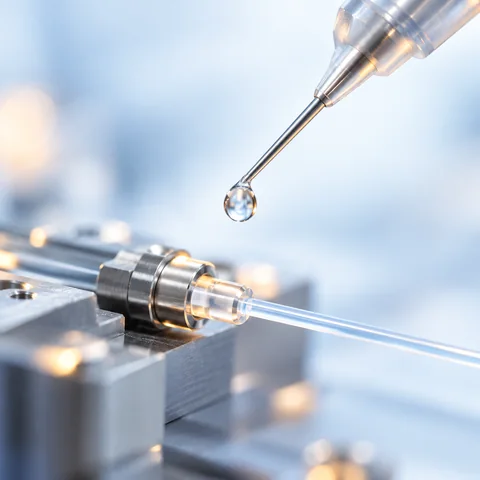
Define the ferrule and fill geometry
Record the ferrule design, fiber position, available clearance, fill depth, dispensing access and the locations where excess flow must be avoided.
Match viscosity to the required flow behavior
Lower viscosity can support filling narrow spaces, while a more controlled-flow material may help limit movement outside the intended area. Confirm behavior on the actual assembly.
Document substrates and surface preparation
Identify the ceramic, glass and adjacent materials, together with cleaning, handling and surface-preparation steps that can affect bonding consistency.
Confirm the thermal-cure process
Define dispensing time, fixture arrangement, oven capability, temperature profile and the thermal limits of nearby components before selecting a cure route.
Qualify the finished connector assembly
Inspect fill quality and bond integrity, then evaluate the optical, mechanical and environmental conditions required for the intended connector or patch-cord application.
INFORMATION CHECKLIST
Prepare these details for a productive material discussion.
- Ferrule, fiber and adjacent materials
- Fill path and bond geometry
- Dispensing access and flow control
- Thermal-cure capability
- Inspection and reliability tests
TECHNICAL FAQ
Questions to clarify before evaluation
Is a lower-viscosity ferrule adhesive always better?
No. The preferred flow behavior depends on the clearance, fill path, dispensing method and the areas that must remain free of adhesive.
Can an adhesive be selected from shrinkage alone?
No. Viscosity, cure process, hardness, bond geometry, substrate compatibility and finished-assembly reliability must also be evaluated.
What assembly details should be shared with the supplier?
Share the ferrule and fiber materials, dimensions, fill path, dispensing method, available cure process and required inspection and reliability tests.