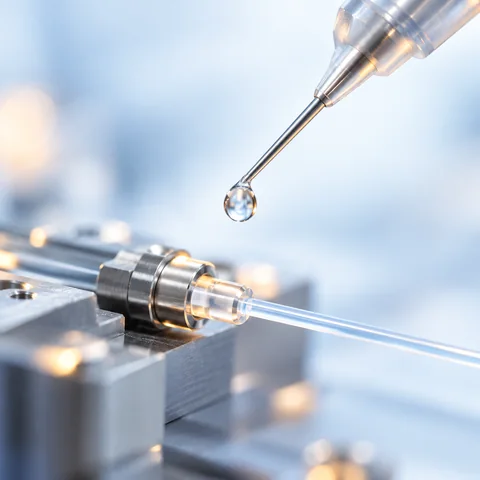
APPLICATION EVALUATION
Start with the complete manufacturing requirement.
- Ferrule, fiber and adjacent substrates
- Fill path and bond geometry
- Dispensing access and flow control
- Thermal-cure capability and finished-part inspection
Low-viscosity ferrule potting
Low-Viscosity Ceramic Ferrule Potting Adhesive
TZ-FEP-401
A two-component, low-viscosity thermal-cure adhesive for ceramic ferrule and fiber patch-cord potting.
Evaluation focus
- Low-viscosity filling
- Short thermal cure
- Low shrinkage
Ceramic ferrule and fiber patch-cord potting
TZ-FEP-401
- Viscosity
- 3–5 Pa·s
- Cure conditions
- 120°C × 5 min
- Hardness
- >Shore D 80
- Shrinkage
- 1–2%
- Glass-transition temperature
- >90°C
- Storage temperature
- 10–30°C
Controlled-flow ferrule potting
Controlled-Flow Ceramic Ferrule Potting Adhesive
TZ-FEP-402
A semi-transparent, medium-to-high-viscosity thermal-cure adhesive for controlled-flow ferrule potting.
Evaluation focus
- Controlled flow
- Short thermal cure
- Low shrinkage
Ceramic ferrule and fiber patch-cord potting
TZ-FEP-402
- Viscosity
- 8–20 Pa·s
- Cure conditions
- 120°C × 5 min
- Hardness
- >Shore D 80
- Shrinkage
- 1–2%
- Glass-transition temperature
- >90°C
- Storage temperature
- 10–30°C
RELATED TECHNICAL GUIDES
Plan the application before comparing materials.
TECHNICAL FAQ
Questions for application planning
What is the main difference between TZ-FEP-401 and TZ-FEP-402?
The listed viscosity ranges distinguish them: TZ-FEP-401 is lower viscosity and TZ-FEP-402 provides more controlled flow.
Is a lower-viscosity ferrule adhesive always better?
No. The required flow depends on the clearance, fill path, dispensing method and the areas that must remain free of adhesive.
What process details should be provided?
Provide the ferrule and fiber materials, fill geometry, dispensing method, thermal-cure capability and finished-part inspection requirements.